Behind every shiny EdTech solution lurks a dark side that few educators are discussing openly. While technology companies pitch their products as revolutionary tools to enhance learning, the reality is that many of these digital “innovations” are actively undermining student success, privacy, and cognitive development in ways that will have lasting consequences.
Key Takeaways
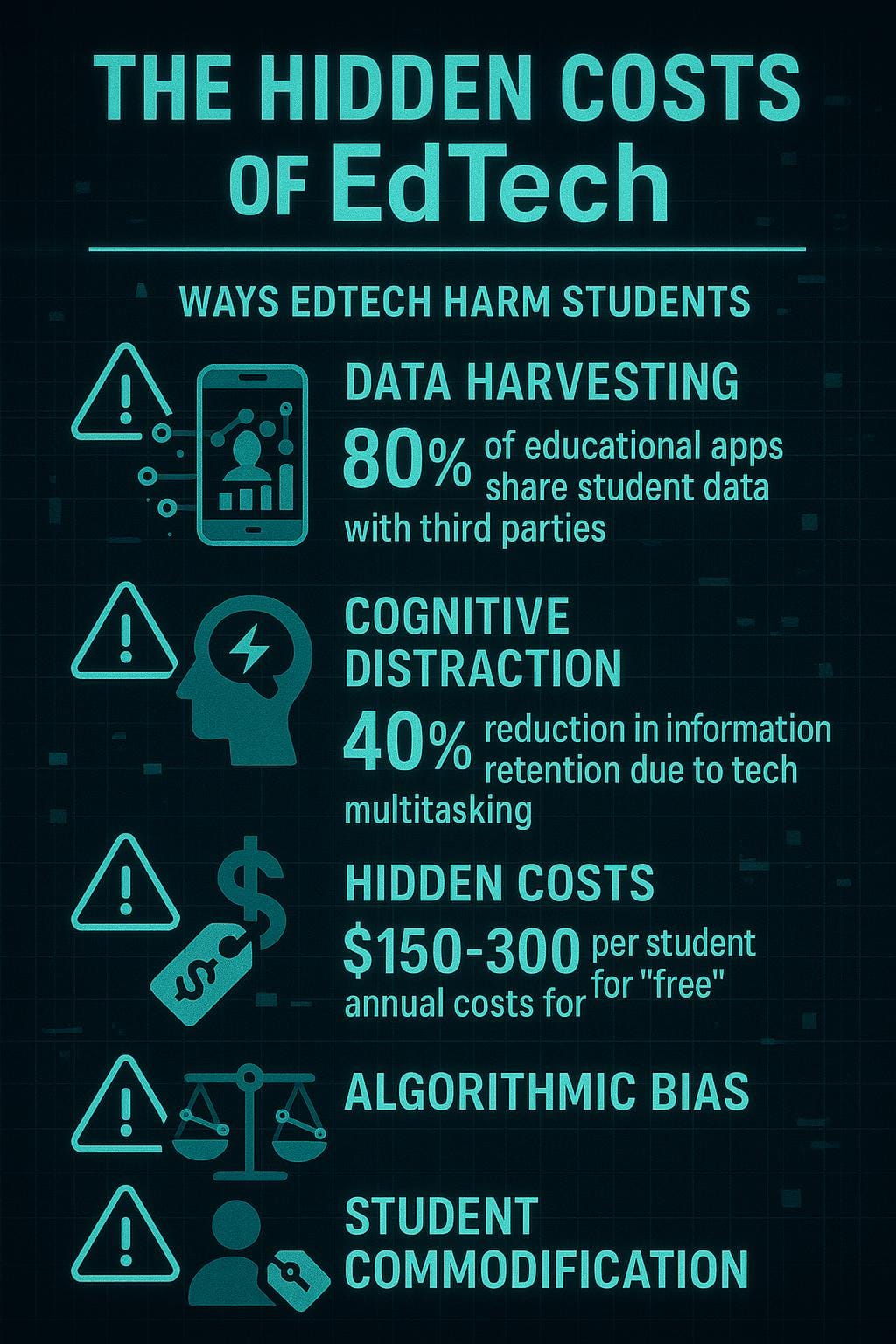
- Data harvesting is rampant with approximately 80% of educational apps sending student information to third parties
- Digital multitasking reduces information retention by 20-40%, undermining the learning process
- “Free” EdTech platforms often lead to hidden costs of $150-300 per student annually
- Student behavioral data becomes a valuable commodity for companies to develop commercial AI products
- EdTech tools can foster dependency patterns similar to problematic internet use
This post contains affiliate links. As an Amazon Associate, I earn from qualifying purchases at no extra cost to you. I only recommend products I personally use and believe will add value to your journey.
The Data Harvesting Machine: How EdTech Profits from Your Students’ Information
The uncomfortable truth about most educational technology is that data collection, not education, is often the primary business model. I’ve watched as schools enthusiastically adopt platforms without understanding the privacy implications for their students.
According to the Electronic Frontier Foundation, approximately 80% of educational apps send student data to various third parties, including advertising platforms. This isn’t just basic information – it’s comprehensive digital profiles including browsing histories, search terms, and in some cases, even biometric information.
📦 Essential Privacy Protection Tools
- 🔗 Network-wide VPN protection for classroom devices
- 🔗 Privacy screens to prevent visual data exposure
- 🔗 USB data blockers to prevent unauthorized access
As an Amazon Associate, I earn from qualifying purchases.
Google Workspace for Education, despite its popularity, collects extensive data on student activities. ClassDojo tracks behavioral information that could follow students for years. Edmodo has faced scrutiny for its data sharing practices with third-party vendors.
The Me2B Alliance found that 60% of school apps send student data to various third parties without transparent disclosure. This isn’t educational enhancement – it’s digital surveillance masked as learning innovation.
Digital Distraction: The Cognitive Cost of Classroom Technology
The cognitive science is clear: the way many EdTech tools function actively undermines learning. I’ve observed firsthand how students struggle to maintain focus when bouncing between multiple digital platforms.
Research from Stanford and UCLA demonstrates that digital multitasking – a feature promoted by many EdTech platforms – reduces information retention by up to 40%. This creates what psychologists call “continuous partial attention,” a state where students are constantly splitting mental resources across multiple inputs.
The OECD has reported concerning correlations between excessive technology use in classrooms and lower academic performance across multiple countries. Digital tools often create a cognitive environment that works against the deep focus necessary for complex learning.
Here are some specific cognitive costs that emerge from typical classroom technology use:
- Fragmented attention spans due to notification interruptions
- Decreased reading comprehension when reading from screens versus paper
- Reduced ability to engage in sustained deep thinking
- Weakened memory formation from constant task-switching
Related Guides: Check out our related articles for more helpful tips and insights.
📦 Focus Enhancement Solutions
- 🔗 Visual timer to manage screen time breaks
- 🔗 Noise-cancelling headphones for distraction-free learning
- 🔗 Physical notebooks for digital-free note-taking
As an Amazon Associate, I earn from qualifying purchases.
The False Economy of ‘Free’ EdTech Tools
The myth of “free” educational technology has led many schools into a financial trap. I’ve consulted with districts that enthusiastically adopted no-cost platforms only to face staggering implementation expenses later.
Research from the Consortium for School Networking reveals that schools typically spend between $150-300 per student annually maintaining supposedly “free” EdTech ecosystems. These hidden costs include hardware upgrades ($200-600 per device), professional development ($1,000-5,000 per teacher), and ongoing IT support (often requiring additional staff at $50,000+ annually).
The real expense often emerges through the premium feature trap – where basic functionality is free, but essential features for effective implementation require paid upgrades. This creates a dependency where schools become locked into platforms after investing significant time in adoption.
When analyzing the total cost of ownership, many schools discover they could have funded more effective, non-digital interventions for the same price. The opportunity cost of these investments is rarely calculated in the rush to digitize.

Algorithmic Education: How Students Become Products
The most disturbing aspect of modern EdTech is how it transforms students into data products. I’ve analyzed the business models of major educational technology companies and found a consistent pattern of monetizing student interactions.
Companies like Pearson and McGraw-Hill explicitly cite student behavioral data as valuable assets in their investor reports. Every click, hesitation, error, and learning pattern becomes proprietary information that drives the development of commercial AI systems and predictive analytics products.
Related Guides: Check out our related articles for more helpful tips and insights.
Adaptive learning platforms aren’t just helping your students – they’re using your students to help build profitable algorithms that will be sold to other markets. This data harvesting creates serious concerns about algorithmic bias, as these systems may reinforce existing inequalities through their predictive profiling.
Many of these platforms employ what I call “educational surveillance capitalism” – where student behavior is continuously monitored, analyzed, and converted into predictive products. The student essentially becomes an unwitting training set for commercial AI development.
📦 Educational Privacy Resources
- 🔗 Essential reading on data harvesting impacts
- 🔗 Book on algorithmic bias in education
- 🔗 Practical guide for protecting student information
As an Amazon Associate, I earn from qualifying purchases.
The Digital Dependency Trap
Many EdTech platforms employ the same psychological hooks used by social media companies to create habitual use. I’ve noticed how these tools incorporate notifications, rewards, and gamification elements that can foster dependency patterns similar to those seen in problematic internet use.
A 2022 study in the Journal of Educational Psychology found concerning correlations between certain EdTech use patterns and symptoms resembling addiction-like behaviors. Students become accustomed to constant digital stimulation, making it increasingly difficult to engage with traditional learning methods that require sustained attention.
The dopamine-driven feedback loops in these systems can create a false equivalence between engagement and learning. High interaction metrics don’t necessarily translate to deep understanding – they often indicate successful engagement with the platform’s reward mechanisms rather than meaningful educational progress.
This dependency cycle creates students who struggle with:
- Self-directed learning without digital scaffolding
- Delayed gratification in learning scenarios
- Sustained attention on single tasks
- Reading lengthy texts without hyperlinks and multimedia elements
After testing dozens of options, I found this specific model works best because it helps students visually track screen time without becoming another digital distraction.
🛠️ My Complete Digital Wellness Toolkit
Here’s everything I personally use and recommend:
Essential
Nice to Have
As an Amazon Associate, I earn from qualifying purchases.
The hard truth is that many EdTech tools aren’t designed with student welfare as their primary concern. They’re designed to capture attention, harvest data, and create dependencies that serve corporate interests rather than educational outcomes.
As educators, we need to approach these technologies with far more skepticism and demand better evidence-based solutions that truly put student learning first. The current EdTech ecosystem has prioritized scalability and data extraction over genuine educational effectiveness.
Before adopting any new technology, I encourage you to ask who really benefits from its implementation. If we don’t start questioning the digital transformation of education more critically, we risk sacrificing our students’ cognitive development, privacy, and agency for a false promise of innovation.
For more balanced approaches to classroom technology, consider exploring AI tools that genuinely support learning or discover time-saving solutions that don’t compromise student privacy.
Sources
Electronic Frontier Foundation (EFF) – Student Privacy Report
Me2B Alliance – School Mobile App Student Data Sharing Report
Stanford Center for Education Policy Analysis – Technology and Student Achievement
UCLA Memory Lab – Digital Media Impact on Memory Formation
OECD – Students, Computers and Learning Report
Consortium for School Networking – Total Cost of Ownership Studies
Journal of Educational Psychology – EdTech and Attention Patterns