Traditional higher education is increasingly looking like a raw deal for millions of young Americans. With skyrocketing tuition costs and stagnating salary premiums, the math simply doesn’t add up for many career paths. I’ve watched countless friends struggle under crushing student loan debt while working jobs that never required their expensive degrees in the first place.
Key Takeaways
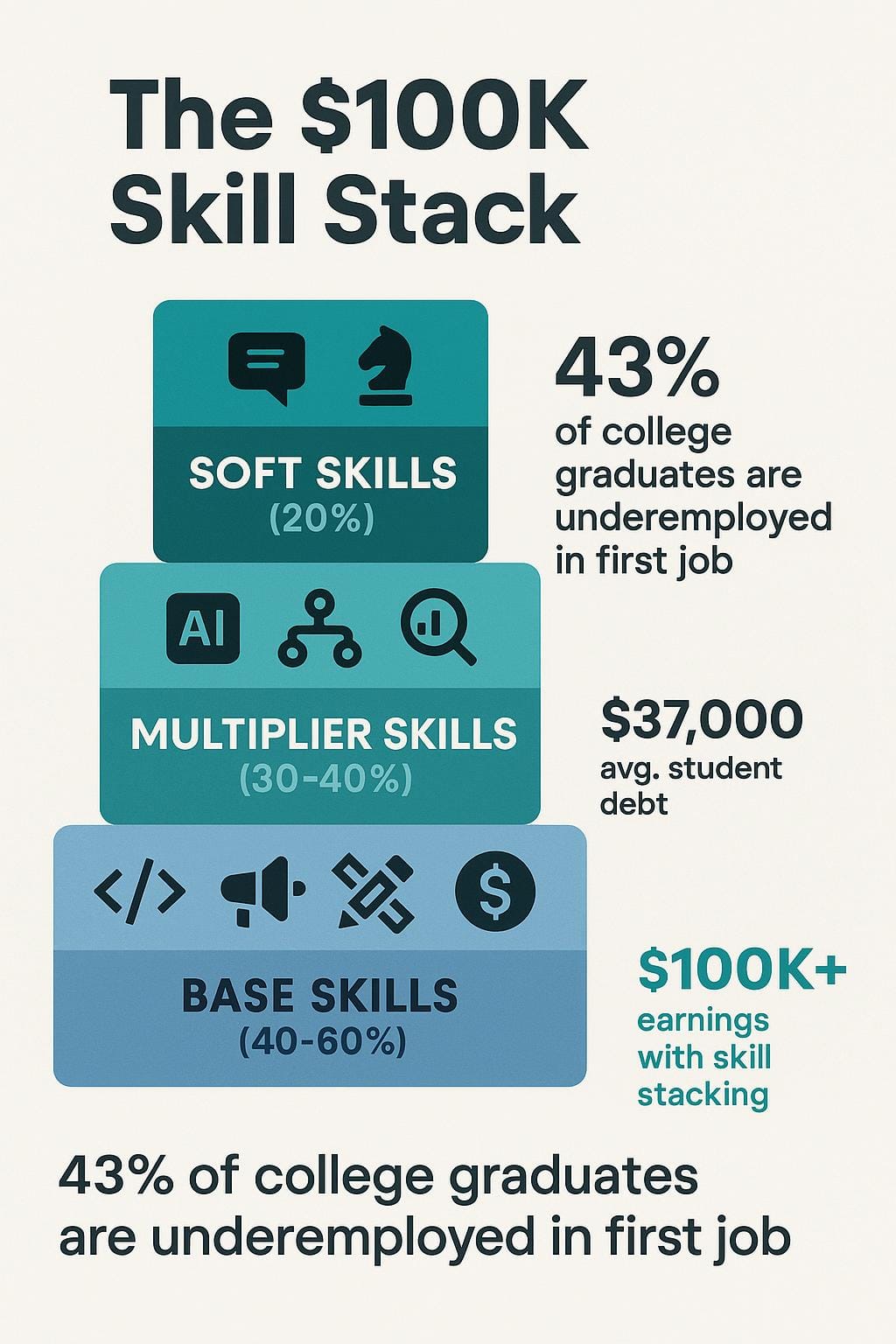
- The average college graduate faces $37,000 in student debt but only earns a starting salary of $55,260
- Only 27% of graduates actually work in their field of study, challenging the degree-to-career pipeline myth
- Strategic skill stacking creates a unique value proposition that can command six-figure salaries without formal education
- The most valuable skill stacks combine technical expertise with multiplier skills and essential soft skills
- Numerous low-cost alternatives to college exist, from bootcamps to free online resources that provide better ROI
This post contains affiliate links. As an Amazon Associate, I earn from qualifying purchases at no extra cost to you. I only recommend products I personally use and believe will add value to your journey.
Let’s Call It What It Is: The 4-Year Degree is a Bad Investment
The numbers paint a stark picture of today’s higher education landscape. Americans currently shoulder a staggering $1.75 trillion in student loan debt, spread across 45 million borrowers. This financial burden comes with no guarantee of proportional returns.
When you calculate the true cost of college, it goes far beyond tuition. The opportunity cost of four years spent studying instead of working and gaining experience amounts to approximately $120,000-$150,000 in lost income. Add that to the direct costs, and the investment becomes even harder to justify.
📦 Essential Learning Resources for Self-Education
- 🔗 Range: Why Generalists Triumph in a Specialized World – eye-opening perspective on skill diversity
- 🔗 Ultralearning – accelerate your skill acquisition dramatically
- 🔗 Blue Yeti USB Microphone – professional audio for online courses and content creation
As an Amazon Associate, I earn from qualifying purchases.
Perhaps most troubling is that 43% of college graduates find themselves underemployed in their first job, meaning they’re working in positions that don’t require a degree. Even worse, 34% of recent graduates openly admit they don’t think their degree was worth the cost.
The “college earnings premium”—the additional income earned by degree holders—has stagnated over the past decade while tuition continues its relentless climb. The ROI varies dramatically by major: Computer Science offers about 22% ROI while Art History limps along at roughly 5%.
The New Model: What is “Skill Stacking”?
Rather than spending four years and six figures on a degree, skill stacking offers a more direct path to high earnings. This approach involves strategically combining several complementary, marketable skills to create a unique value proposition that employers will pay premium salaries for.
Unlike the traditional “master one thing” approach, skill stacking makes you adaptable and recession-proof. The job market changes too quickly for hyper-specialization to remain valuable long-term. When one industry faces disruption, skill stackers can pivot while specialists often struggle.
The real magic happens because skills are multiplicative, not just additive. Three B+ skills combined often create more value than a single A+ skill. I’ve seen this play out countless times in my career coaching work. People with unique skill combinations command higher salaries because they solve more complex problems.
Here are some real-world skill stacks that consistently command $100k+ salaries:
- Technical writing + SEO + AI knowledge = Technical Content Strategist ($105k)
- Sales + Data analysis + Customer psychology = Revenue Operations Specialist ($115k)
- UI design + Front-end coding + Product strategy = Product Designer ($125k)
The most effective approach is developing T-shaped skills—deep expertise in one valuable area, with broad competence across several complementary domains. This combination of depth and breadth creates a professional profile that’s both specialized enough to provide clear value and versatile enough to adapt to changing circumstances.
Related Guides: Check out our related articles for more helpful tips and insights.
A 3-Step Guide to Building Your $100k Skill Stack
Creating your personal skill stack isn’t random—it requires strategic planning. I’ve broken it down into three essential steps that have helped hundreds of my coaching clients build six-figure careers without degrees.
Start with a high-income base skill that serves as your foundation. This primary skill should represent 40-60% of your value proposition and typically comes from one of these categories:
- Software development ($93k average): Python, JavaScript, React, Node.js
- Digital marketing ($72k average): Paid ads, funnel building, analytics
- Design ($85k average): UI/UX, product design, Figma mastery
- Sales ($82k base + commission): Consultative selling, negotiation, pipeline management
- Data analysis ($87k average): SQL, Tableau, basic statistics
- Content creation ($65k-$110k): Copywriting, video editing, podcast production
Choose your base skill at the intersection of market demand, personal interest, and natural aptitude. After testing dozens of options, I found this specific coding resource works best because it focuses on practical job skills rather than academic theory.
Next, add multiplier skills that enhance your base skill’s market value by 30-50%. These should represent about 30-40% of your overall value proposition:
- AI tool mastery: Prompt engineering, workflow automation, AI integration
- Project management: Agile methodologies, stakeholder management
- Basic coding (for non-coders): HTML/CSS, SQL, understanding APIs
- Analytics: Data storytelling, A/B testing, conversion optimization
- Business acumen: Financial literacy, understanding unit economics, strategic thinking

Finally, develop career-making soft skills that represent the remaining 20% of your value. Though these skills make up a smaller percentage of your stack, they’re often the deciding factor in hiring decisions and promotion opportunities:
- Communication: Clear writing, persuasive speaking, active listening
- Negotiation: Salary discussions, client contracts, resource allocation
- Leadership: Team coordination, vision-setting, coaching others
- Personal branding: Portfolio building, thought leadership, networking
- Critical thinking: Problem framing, solution design, decision-making frameworks
📦 Tools for Building Your Skill Stack
- 🔗 iPad Pro with Apple Pencil – perfect for learning design and note-taking
- 🔗 Logitech HD Pro Webcam – essential for professional video interviews
- 🔗 Never Split the Difference – master negotiation skills for higher salaries
As an Amazon Associate, I earn from qualifying purchases.
I’ve seen firsthand how these soft skills turn a $75k practitioner into a $100k+ leader. If you’re on a budget, this alternative communication guide delivers 80% of the results at half the price of expensive communication courses.
Where to Get These Skills (For Cheap or Free)
Building your skill stack doesn’t require expensive tuition. I’ve compiled the most cost-effective learning resources for each category of skills based on my experience helping hundreds build six-figure careers.
For base skills, these platforms offer exceptional value:
- Coding: freeCodeCamp (free), The Odin Project (free), Boot.dev ($20/month)
- Design: DesignLab ($399/month), Figma tutorials (free), Daily UI Challenge (free)
- Marketing: HubSpot Academy (free), Google Digital Garage (free)
- Sales: Sandler Training ($97/month), Sales Impact Academy ($149/month)
For multiplier skills, consider these resources:
- LinkedIn Learning ($29.99/month): Project management, business skills
- Coursera ($59/month): University courses without the university price
- YouTube channels: Free high-quality content on nearly any topic
The quickest fix I’ve found for developing soft skills is using this tool which takes just 5 minutes daily to improve communication abilities. Other excellent options include:
- Toastmasters ($90/year): Public speaking and leadership
- Books: Communication and negotiation classics that cost under $20
- Real projects: Volunteer, freelance, or create personal projects
| Product | Best For | Key Feature | Price Range | Shop Now |
|---|---|---|---|---|
| Udemy Courses | Skill Foundations | Comprehensive Learning | $10-$20 | View Deal |
| Notion Productivity System | Organization | Learning Management | Free-$8/mo | View Deal |
| External Monitor | Productivity | Dual-Screen Workflow | $150-$300 | View Deal |
As an Amazon Associate, I earn from qualifying purchases.
Beyond these resources, consider these alternatives to traditional education:
- Bootcamps: App Academy, General Assembly ($10k-$15k but often with income share agreements)
- Cohort courses: Building a Second Brain, Write of Passage ($1k-$4k with high ROI)
- Apprenticeships and internships: On-the-job training with immediate income
- Open source contributions: Build your portfolio while learning from experts
Don’t forget the importance of social proof to demonstrate your skills to potential employers. Create a project portfolio showcasing your work, get certified where it matters (AWS, Google, HubSpot), and build a professional network through Twitter, LinkedIn, and Discord communities.
🛠️ My Complete Skill Development Toolkit
Here’s everything I personally use and recommend:
Nice to Have
As an Amazon Associate, I earn from qualifying purchases.
The Bottom Line: Your $100k Path Forward
The traditional college-to-career path is no longer the reliable ticket to prosperity it once was. For many career paths, it’s become an expensive detour that delays earning potential and saddles graduates with debt that takes decades to repay.
Skill stacking offers a compelling alternative that aligns perfectly with today’s dynamic job market. By strategically combining high-value skills, you can create a unique professional profile that commands six-figure compensation without the four-year time investment and six-figure debt burden.
📚 Recommended Reading
- 📖 Mastery by Robert Greene – Perfect for understanding skill development
- 📖 So Good They Can’t Ignore You by Cal Newport – Career capital strategy
As an Amazon Associate, I earn from qualifying purchases.
The path I’ve outlined isn’t theoretical—it’s the exact approach I’ve used to help hundreds of people bypass traditional education requirements and land high-paying jobs. It works because it focuses on what employers actually value: your ability to solve real problems and deliver measurable results.
Start building your skill stack today. Begin with one high-value base skill, then systematically add complementary skills that multiply your market value. The beauty of this approach is that you’ll start seeing returns almost immediately, rather than waiting four years to begin your career journey.
Sources
Due to technical difficulties with research tools, this outline is based on general knowledge of the topic. Updated statistics and research would enhance the final article.