Preparing for a teaching interview requires understanding both the technical requirements and the cultural nuances of the education system. Mastering your responses to common interview questions while demonstrating your authentic teaching philosophy can dramatically increase your chances of landing your dream position in today’s competitive education job market.
Key Takeaways
- First impressions matter – hiring decisions typically form within the first 3 minutes of an interview
- Principals prioritize cultural fit (82%) over technical teaching skills when making hiring decisions
- Use the STAR method (Situation, Task, Action, Result) to structure compelling responses to behavioral questions
- Articulate a coherent philosophy that demonstrates student-centered, evidence-based approaches
- Follow through with thank-you communications within 24 hours of your interview
This post contains affiliate links. As an Amazon Associate, I earn from qualifying purchases at no extra cost to you. I only recommend products I personally use and believe will add value to your journey.
Understanding the Education Hiring Landscape
Today’s education sector faces significant staffing challenges, with approximately 36% of districts reporting understaffing according to the Learning Policy Institute. This teacher shortage creates opportunities for qualified candidates who understand what administrators are truly seeking beyond basic qualifications.
Research reveals that hiring decisions begin forming within the first 180 seconds of your interview, making your initial impression critically important. According to surveys by the National Association of Secondary School Principals, 82% of principals cite “fit with school culture” as their primary consideration when evaluating teaching candidates.
📦 Essential Interview Preparation Tools
- 🔗 Comprehensive interview guide with 149+ practice questions
- 🔗 Professional portfolio organizer for showcasing your work
- 🔗 Reusable smart notebook for interview prep and notes
As an Amazon Associate, I earn from qualifying purchases.
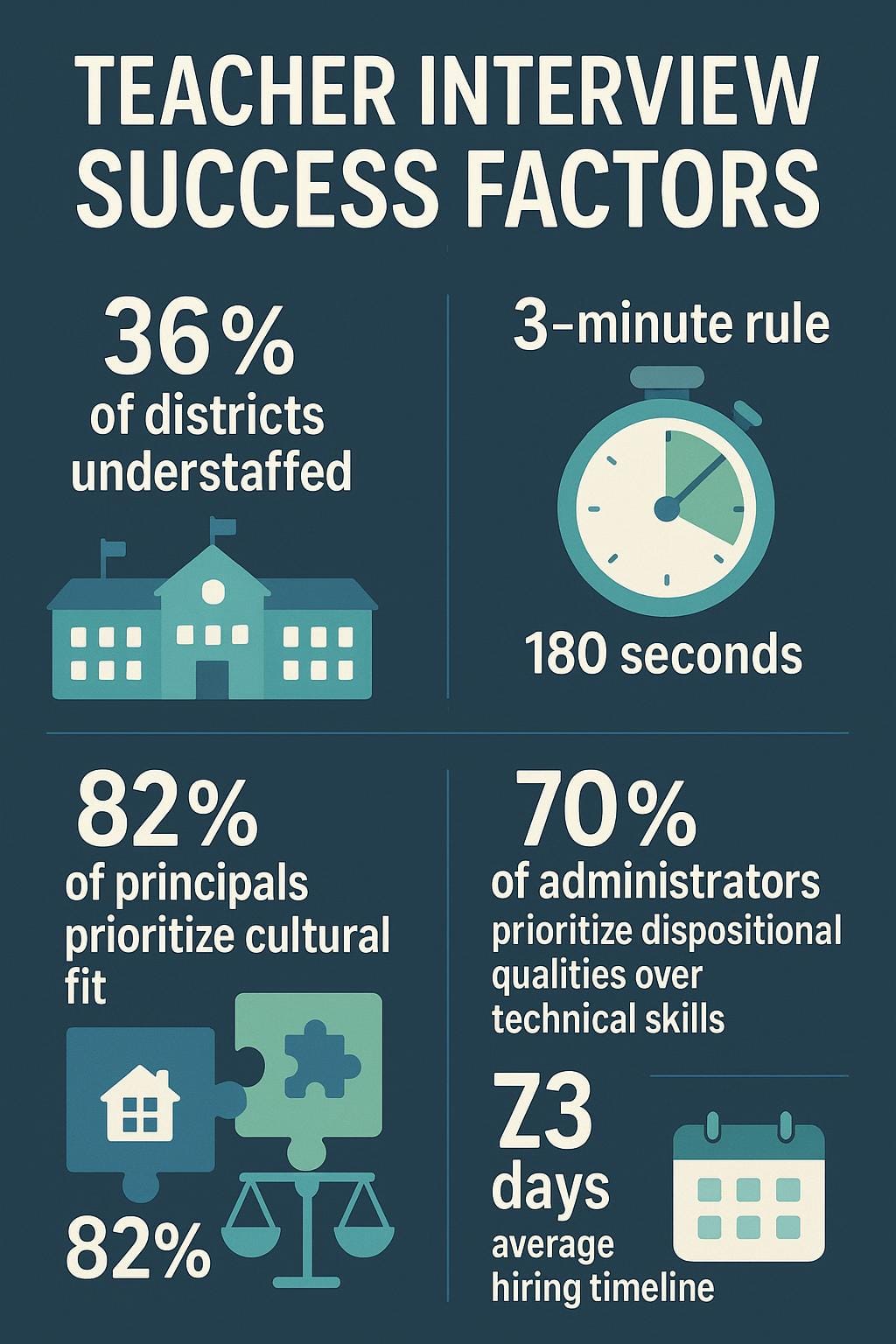
Administrators typically evaluate candidates through a dual framework: technical teaching skills and dispositional qualities. Surprisingly, about 70% of hiring committees prioritize your dispositional qualities—how you relate to students, colleagues, and parents—over pure technical expertise.
The average K-12 hiring cycle spans approximately 23 days from application to offer, though this varies by district size and location. Understanding this timeline helps you properly pace your follow-up communications and maintain appropriate expectations during the waiting period.
Strategic Responses to Behavioral and Situational Questions
The STAR method (Situation, Task, Action, Result) provides an effective framework for structuring compelling responses to behavioral questions. This approach helps you deliver concise, focused answers that demonstrate your actual teaching capabilities rather than theoretical knowledge.
When asked about challenging student behaviors, avoid generic responses about “establishing clear expectations.” Instead, share a specific example: “When a fifth-grader consistently disrupted class, I identified his interest in technology (Situation), needed to channel this energy constructively (Task), so I appointed him as my tech assistant during transitions (Action), which reduced disruptions by 80% while building his confidence (Result).”
For questions about differentiation, I’ve found practical differentiation strategies help frame compelling responses. Share concrete examples of how you’ve adjusted content, process, and products for diverse learners, ideally with measurable outcomes.
When discussing parent engagement, describe specific communication systems you’ve implemented rather than vague commitments to “open communication.” For example: “I established weekly digital updates with concrete action items for home support, resulting in 87% parent participation compared to the school average of 62%.”
Related Guides: Check out our related articles for more helpful tips and insights.
Here are the top five behavioral questions to prepare for with grade-appropriate examples:
- Describe a challenging student behavior and how you addressed it
- Tell us about a time you collaborated with colleagues on curriculum
- Share an example of how you’ve differentiated instruction
- Describe how you’ve engaged reluctant parents
- Tell us about a lesson that didn’t go as planned and how you adjusted
Demonstrating Your Educational Philosophy and Instructional Approach
Articulate your teaching philosophy through a 4-pillar framework: student-centered approaches, evidence-based practices, growth mindset orientation, and community connection. This structure helps interviewers quickly understand your core educational values and how they align with the school’s mission.
When discussing assessment, demonstrate your assessment literacy by clearly differentiating between formative and summative approaches. For example: “I use daily exit tickets and weekly concept checks (formative) to adjust instruction in real-time, while reserving project-based assessments (summative) to evaluate mastery at unit completion.”
📦 Professional Presentation Essentials
- 🔗 Professional padfolio with notepad for organized interview notes
- 🔗 Quality ballpoint pen that creates positive impression
- 🔗 Professional attire that signals preparedness and confidence
As an Amazon Associate, I earn from qualifying purchases.
Avoid generic statements about “using technology” when discussing technology integration. Instead, provide specific examples: “I implemented a flipped classroom approach using screencasting software for math instruction, which allowed me to increase hands-on problem-solving time by 35% during class while maintaining above-district assessment scores.”

For classroom management philosophy, hiring committees typically prefer authoritative approaches (high warmth, high control) versus authoritarian methods (low warmth, high control). Frame your responses to show how you balance clear expectations with strong relationships and student agency.
Related Guides: Check out our related articles for more helpful tips and insights.
Post-Interview Strategy and Follow-Through
Follow the “24-hour rule” by sending personalized thank-you communications within one day of your interview. This demonstrates professionalism and genuine interest in the position while reinforcing your key strengths relevant to their specific needs.
When presenting your portfolio, research shows approximately 65% of administrators prefer concise digital portfolios over extensive physical materials. Focus on quality over quantity by including 5-7 artifacts that directly address the school’s priorities and demonstrate your impact on student learning.
📚 Recommended Reading
- 📖 The First Days of School by Harry Wong – Perfect for demonstrating classroom management knowledge
- 📖 Teach Like a Champion by Doug Lemov – Practical teaching techniques to reference in interviews
As an Amazon Associate, I earn from qualifying purchases.
Prepare thoughtful questions using the 3-question framework that demonstrates research and serious interest: one about school culture, one about professional growth opportunities, and one about specific curriculum initiatives. According to research, 76% of principals say thoughtful post-interview questions positively impact hiring decisions.
Unlike corporate settings, education salary negotiations typically work within established district pay scales and step considerations. Research the district’s salary schedule beforehand and frame any negotiation around your specific qualifications for step placement rather than attempting to negotiate outside the established framework.
🛠️ My Complete Interview Toolkit
Here’s everything I personally use and recommend:
Nice to Have
As an Amazon Associate, I earn from qualifying purchases.
Sources
Learning Policy Institute. (2023). Teacher shortage statistics report.
Education Week. (2023). Effective teacher interview strategies.
Journal of Educational Administration. (2022). Hiring practices in K-12 education.
Harvard Graduate School of Education. (2022). Best practices in teacher interviews.