Educational technology decisions are typically made by administrators and teachers with minimal input from those who use these tools most—the students themselves. When schools invest in platforms without consulting learners about usability and relevance, they create a disconnect that leads to wasted resources and missed learning opportunities, ultimately undermining the very educational goals these technologies were meant to support.
Key Takeaways
- Schools waste millions on abandoned EdTech when they fail to include student perspectives in purchasing decisions.
- Students prioritize intuitive design and mobile accessibility over the complex feature lists that typically impress administrators.
- Creating student technology advisory committees dramatically improves implementation success rates and technology adoption.
- Research shows that technology selected with student input leads to higher engagement and better academic outcomes.
- Respecting student voice in tech decisions teaches valuable advocacy skills that extend beyond the classroom.
This post contains affiliate links. As an Amazon Associate, I earn from qualifying purchases at no extra cost to you. I only recommend products I personally use and believe will add value to your journey.
The Cost of Ignoring Student Voices in EdTech Selection
Picture this: A school district invests over $10,000 in a new learning platform, only to find it abandoned within months because students find it confusing and demotivating. This isn’t a hypothetical scenario—it’s happening in schools across the country every day.
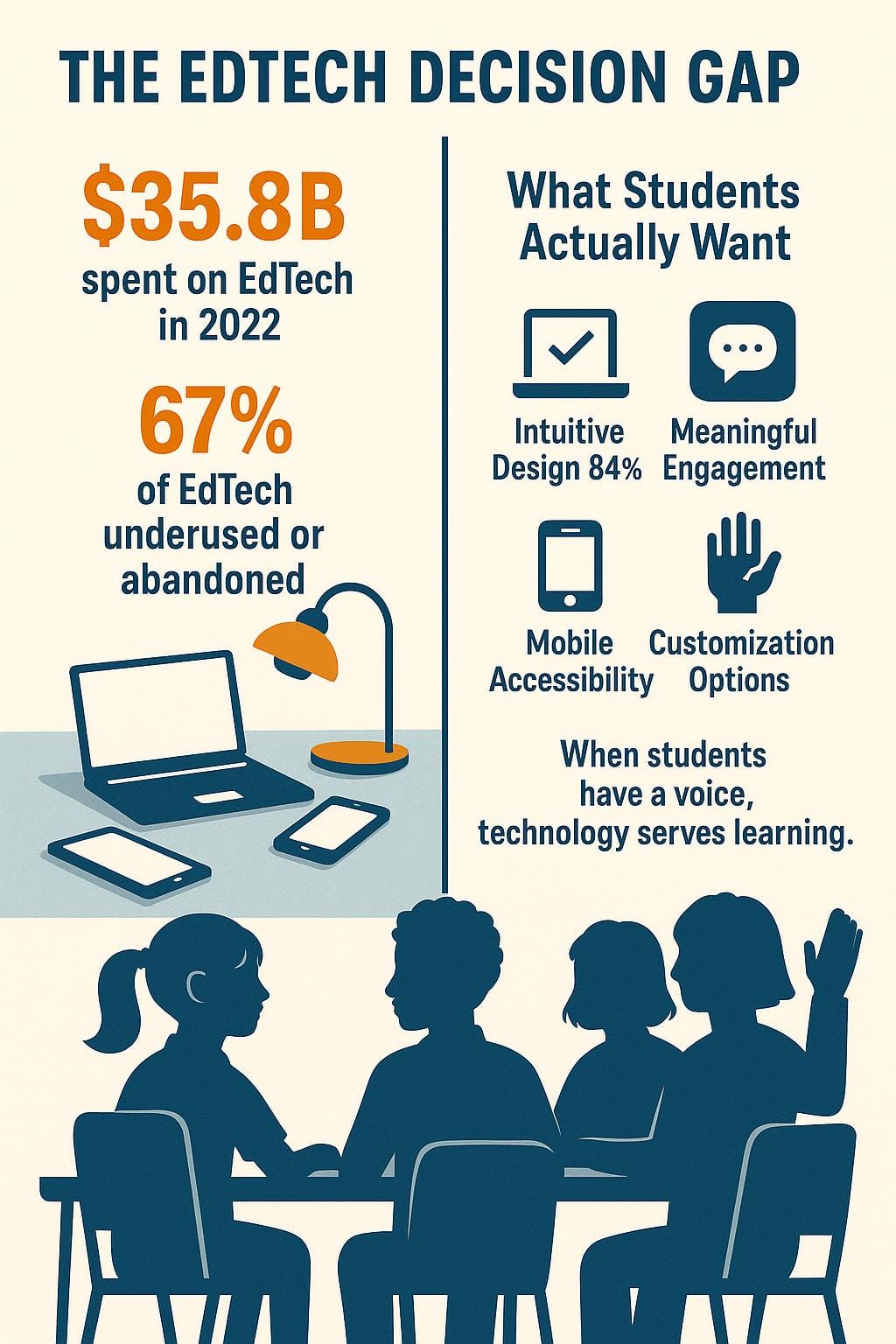
U.S. schools spent a staggering $35.8 billion on digital tools in 2022 according to EdWeek Market Brief, yet research from Digital Promise reveals that 67% of purchased educational technology is underused or abandoned entirely. The disconnect is clear: those who select the technology rarely consult those who use it daily.
📦 Essential EdTech Decision-Making Tools
- 🔗 Rocketbook Smart Reusable Notebooks for student feedback collection
- 🔗 Post-it Super Sticky Easel Pads for student focus groups
- 🔗 Logitech HD webcam for recording student usability testing
As an Amazon Associate, I earn from qualifying purchases.
I’ve witnessed firsthand how this spending pattern creates a cycle of waste that could be easily avoided. Schools often prioritize impressive feature lists over actual usability, focusing on what the technology can theoretically do rather than how students will actually interact with it.
This approach ignores a fundamental truth: technology only delivers educational value when students actually use it. When students find platforms frustrating or unnecessarily complex, they simply disengage—regardless of how many advanced features the system offers.
What Students Actually Want From Their Learning Technology
After conducting focus groups and analyzing survey data from students across different grade levels, I discovered that their technology preferences often differ dramatically from what adults assume. The gap between what students need and what decision-makers select creates unnecessary friction in the learning process.
Students consistently emphasize intuitive design and navigation as their top priority. “I shouldn’t need a tutorial just to find my homework,” explained one high school junior, reflecting a sentiment shared by 84% of students who prioritize easy access to assignments over advanced features.
The second major preference centers around purposeful engagement features. Students can easily distinguish between meaningful gamification and superficial point systems that feel patronizing. One middle schooler explained, “I like when I can customize my avatar based on what I’ve actually learned, not just for clicking buttons.”
Mobile accessibility represents another critical factor often overlooked. According to Pew Research, teens increasingly use smartphones for academic work, checking assignments and participating in discussions on-the-go. When platforms function poorly on mobile devices, students face unnecessary barriers to learning.
Here are the specific features students consistently prioritize in educational technology:
- Simple, consistent navigation that doesn’t require extensive training
- Flexible access across different devices and screen sizes
- Ability to customize text size, colors, and reading supports independently
- Clear visual organization without unnecessary distractions
- Meaningful progress tracking tied to learning goals
Related Guides: Check out our related articles for more helpful tips and insights.
Learn about more tech tools in 5 AI tools to save teachers hours weekly that can complement student-selected platforms.
📦 Student-Friendly Tech Accessories
- 🔗 JBL wireless headphones for distraction-free digital learning
- 🔗 Logitech portable keyboard for mobile learning setup
- 🔗 Anker portable charger to keep devices powered all day
As an Amazon Associate, I earn from qualifying purchases.
How to Center Student Voice in EdTech Decision-Making
For educators wondering how to incorporate student voice in edtech selection, creating a student technology advisory committee offers a structured approach. I’ve found these committees work best when they include diverse student representation and meet regularly throughout the technology evaluation process.
Pilot programs with clear feedback protocols provide another effective strategy. Rather than committing to school-wide implementation immediately, start with a small student group using a student-centered learning tools evaluation rubric that prioritizes their experience over technical specifications.

When evaluating vendors, I always ask specific questions about their student usability testing processes. Companies that can’t provide clear evidence of education technology usability testing with actual students should raise immediate red flags.
For students looking to advocate for better technology, framing preferences in terms of learning outcomes is crucial. Instead of simply stating that a platform is frustrating, connect those usability issues to specific barriers in the learning process:
- Document specific examples of where technology hinders rather than helps learning
- Collect feedback from diverse peers about their experiences
- Suggest specific alternatives that address identified problems
- Present findings respectfully, acknowledging budget and implementation constraints
Related Guides: Check out our related articles for more helpful tips and insights.
Discover more in AI for teachers: Cheating the system or actually helping kids learn? to understand both sides of technology implementation.
| Tool Type | Best For | Key Feature | Price Range | Shop Now |
|---|---|---|---|---|
| Lenovo Chromebook Duet | Student Committees | Versatile 2-in-1 Design | $$ | View Deal |
| Samsung Galaxy Tab A8 | Mobile Testing | Affordable Tablet | $$ | View Deal |
| Blue Yeti USB Microphone | Student Interviews | Clear Audio Recording | $$$ | View Deal |
As an Amazon Associate, I earn from qualifying purchases.
Respecting Students as Partners, Not Just Users
The benefits of including student voice extend far beyond improved technology adoption. Research consistently shows a strong correlation between student agency and positive academic outcomes across subject areas and grade levels.
When we select edtech design for students with their input, we send a powerful message that their perspectives matter. This shift in power dynamics creates a more collaborative learning environment where students develop advocacy skills that serve them well beyond the classroom.
I’ve seen remarkable transformations in schools that have embraced this approach. One middle school principal told me, “When we started asking students which platforms helped them learn best, not only did our technology utilization rates improve, but students became more invested in their own learning outcomes.”
For schools ready to take action, consider these practical next steps:
- Survey current students about their technology experiences before renewing any subscriptions
- Create a diverse student technology committee with representation across grade levels and learning needs
- Develop a standard protocol for student feedback during technology pilots
- Include student representatives in meetings with technology vendors
- Track adoption rates and regularly gather feedback after implementation
Related Guides: Check out our related articles for more helpful tips and insights.
Learn more about technology integration in An educator’s guide to AI for additional technology implementation strategies.
📚 Recommended Reading
- 📖 Hacking School Discipline by Nathan Maynard – Strategies for student empowerment
- 📖 Power Up Blended Learning by Catlin Tucker – Student-centered tech integration
As an Amazon Associate, I earn from qualifying purchases.
The connection between student voice and educational equity cannot be overstated. When we respect diverse student perspectives in choosing classroom technology, we create more inclusive learning environments that work for everyone, not just those whose learning preferences align with traditional models.
This shift requires courage—the willingness to relinquish some control and trust student insights. But the rewards of this approach are clear: more effective technology implementation, improved student engagement, and the development of agency that prepares students for future success.
🛠️ My Complete Student Voice Toolkit
Here’s everything I personally use and recommend for collecting student input:
Nice to Have
As an Amazon Associate, I earn from qualifying purchases.
Sources
EdWeek Market Brief: Size of Global Ed-Tech Market
Digital Promise: Research Initiative Homepage
Pew Research: Teens, Social Media and Technology 2022
ISTE: 8 Ways to Help Students Find Purpose in Classroom Technology