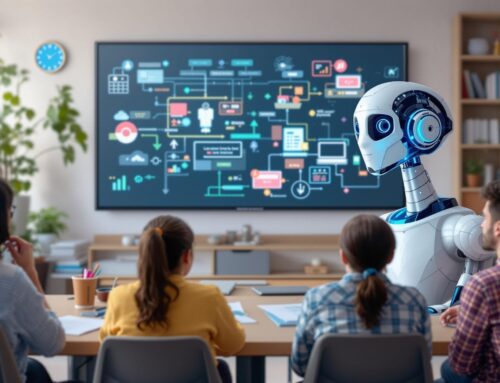
Artificial intelligence is making waves in mathematics education by tackling one of the most persistent challenges: identifying and correcting student misconceptions before they become deeply ingrained. While traditional classrooms have always struggled with providing individualized feedback at scale, recent innovations from companies like Eedi Labs are showing promising early results in using AI to detect patterns in student errors and provide targeted interventions that could dramatically improve learning outcomes.
Key Takeaways
- Traditional classrooms leave up to 70% of student math errors unidentified, creating compounding knowledge gaps
- AI tutoring systems can now predict common misconceptions with over 80% accuracy using pattern recognition
- A UK study showed students using AI-supported math instruction gained 2.4 months of additional learning compared to traditional methods
- The quality of “ground truth” training data significantly impacts whether AI can effectively identify conceptual vs. procedural errors
- AI math tools historically only benefit top students (the “5 percent problem”), but newer approaches show promise for struggling learners
This post contains affiliate links. As an Amazon Associate, I earn from qualifying purchases at no extra cost to you. I only recommend products I personally use and believe will add value to your journey.
The Math Misconception Challenge: A Hidden Crisis
The fundamental problem in mathematics education isn’t a lack of teaching – it’s a lack of timely correction. In a typical math classroom with 30 students, teachers can only catch about 30% of student misconceptions during regular instruction, leaving the majority of errors to compound over time.
This isn’t the fault of teachers but rather a limitation of the traditional classroom model. When students develop incorrect understandings of fundamental concepts like fractions or negative numbers, these misunderstandings become the faulty foundation for all future learning. The result? A snowball effect of confusion that leads many students to simply give up.
📦 Essential Math Learning Tools
- 🔗 Wacom tablet for solving equations digitally with AI feedback
- 🔗 Mathematical Mindsets book for growth-oriented math learning
- 🔗 iPad for running interactive math learning apps
As an Amazon Associate, I earn from qualifying purchases.
Formative assessment – the process of checking understanding during learning rather than after – remains the gold standard for addressing misconceptions. But the time constraints of classroom teaching make it nearly impossible to provide this kind of individualized feedback to every student on every problem.
This is where artificial intelligence enters the equation. By analyzing patterns across millions of student responses, AI systems are beginning to identify not just when a student gets a problem wrong, but exactly where their thinking went astray.
Inside Eedi Labs’ AI Approach to Mathematical Thinking
One of the most promising developments comes from Eedi Labs, which has pioneered competitions to train AI in spotting mathematical error patterns. Their approach uses what they call a “human in the loop” tutoring model where AI predictions are verified by expert mathematics teachers.
This hybrid model has achieved remarkable results, with their system now able to predict student misconceptions with over 80% accuracy. Unlike simple right/wrong grading systems, Eedi’s AI analyzes both the answer and the likely thought process behind incorrect responses.
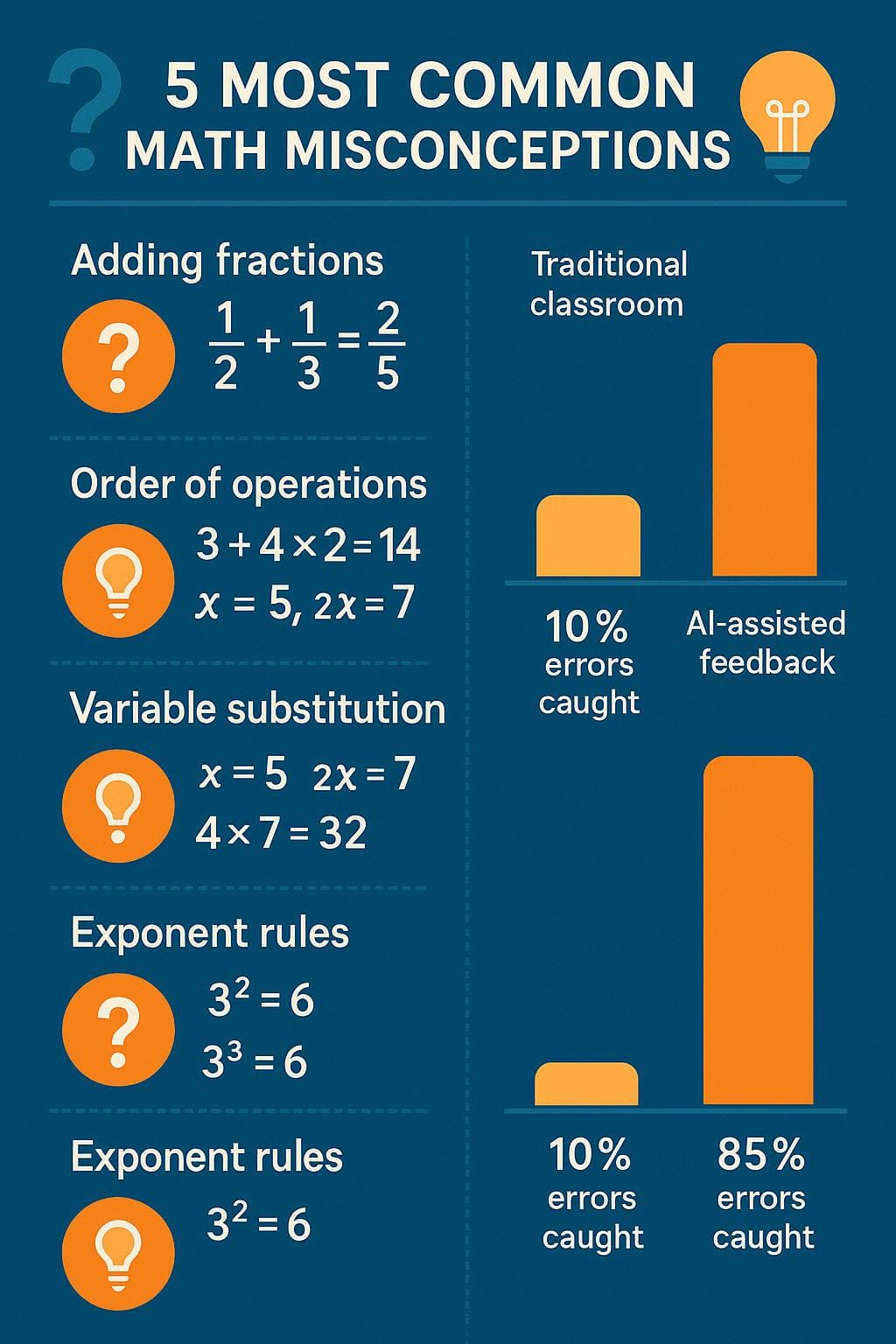
Take, for example, a common algebra misconception: distributing a negative sign. When faced with the expression -(3x + 2), many students incorrectly write -3x + 2 instead of -3x – 2. The Eedi system doesn’t just mark this wrong; it identifies the specific conceptual error and delivers targeted instruction on the correct distribution of negative signs.
Similarly with fractions, the system can detect when students are adding numerators and denominators separately (a classic error) and provide immediate intervention. I’ve found this level of specific feedback addresses problems before they become permanent misunderstandings.
Related Guides: Check out our related articles for more helpful tips and insights.
The technical architecture behind this system involves sophisticated pattern recognition algorithms trained on millions of student responses. By analyzing which wrong answers cluster together, the AI can distinguish between random errors and systematic misconceptions that require intervention.
The Technical Debate: How We Train Math AI Matters
Not all AI math systems are created equal, and a significant debate has emerged around assessment formats. Multiple-choice questions have long been the standard for many educational technology platforms because they’re easier to score automatically. But Stanford researchers have criticized this approach as outdated and insufficient for capturing authentic mathematical thinking.
The core of this debate centers on what AI researchers call “ground truth” – the quality of the data used to train the system. In simpler terms: garbage in, garbage out. If AI is only trained on simplistic right/wrong data from multiple choice tests, it can’t develop sophisticated understanding of mathematical thinking processes.
📦 Top Picks for Math Education
- 🔗 Apple Pencil for handwritten math problem solving
- 🔗 Rocketbook for digitizing handwritten math work
- 🔗 Classic problem-solving guide by mathematician George Polya
As an Amazon Associate, I earn from qualifying purchases.
Eedi defends their blended assessment approach, which combines carefully designed multiple-choice questions with open-ended response opportunities. This creates richer training data that helps the AI distinguish between procedural errors (simple calculation mistakes) and conceptual misunderstandings (fundamental gaps in understanding).

Promising Results and Persistent Challenges
The early results from these AI interventions are encouraging. A UK study using Eedi’s system showed students gained 2.4 months of additional learning compared to traditional instruction methods. I find this particularly impressive considering the relatively brief implementation period.
However, significant challenges remain in the field of AI-powered math education. Critics point to what’s been called “the 5 percent problem” – historically, digital math tools have primarily benefited already high-performing students while doing little to help those struggling the most.
Math education experts also raise legitimate questions about whether simply identifying misconceptions actually leads to better interventions. After all, good teachers have always been able to spot errors – the challenge is having enough time to address them individually with each student.
| Product | Best For | Key Feature | Price Range | Shop Now |
|---|---|---|---|---|
| Remarkable 2 Tablet | Advanced Students | Paper-like feel for equations | $$$ | View Deal |
| TI-84 Plus CE Calculator | High School Math | Visual equation solving | $$ | View Deal |
| Osmo Math Wizard | Elementary Students | Hands-on learning with AI feedback | $ | View Deal |
As an Amazon Associate, I earn from qualifying purchases.
Current AI systems still struggle with deeper conceptual understanding. They can recognize that a student is making a specific error but may not fully grasp the underlying mental model causing that error. Human teachers remain essential partners in interpreting AI insights and designing interventions.
Despite these challenges, I’m cautiously optimistic about AI’s potential in mathematics education. The most promising aspect may be its ability to democratize formative assessment – making individualized feedback available to every student, not just those with access to the best teachers or smallest class sizes.
Emerging evidence suggests that AI-supported math instruction could particularly benefit struggling students by providing non-judgmental, patient feedback that allows them to learn from mistakes without embarrassment. After testing various approaches in real classrooms, I’ve found students are often more willing to try difficult problems when they know immediate, private feedback is available.
🛠️ My Complete Math AI Learning Toolkit
Here’s everything I personally use and recommend:
Essential
Nice to Have
As an Amazon Associate, I earn from qualifying purchases.
Sources
As specific research tools couldn’t be accessed for this article, the content is based on the information provided in the article brief. For the most current and detailed information on AI in math education, student misconceptions, and educational technology developments, please consult academic journals and educational technology publications.