Brain teasers represent a fascinating intersection of education and entertainment, offering cognitive development benefits that extend far beyond simple fun. Research consistently demonstrates that engaging with different types of puzzles stimulates multiple brain regions simultaneously, strengthening neural pathways and enhancing critical thinking abilities across various age groups.
Key Takeaways
- Regular engagement with brain teasers can improve cognitive function by 14% in children aged 6-12
- Different puzzle types target specific mental abilities – logic puzzles enhance deductive reasoning while word puzzles boost verbal intelligence
- Children who regularly solve puzzles score 17% higher on problem-solving assessments
- Age-appropriate brain teasers create an optimal learning progression that grows with your child’s development
- Family puzzle nights provide both cognitive benefits and valuable bonding opportunities
This post contains affiliate links. As an Amazon Associate, I earn from qualifying purchases at no extra cost to you. I only recommend products I personally use and believe will add value to your journey.
The Fascinating Science Behind Brain Teasers
Brain teasers are more than just entertaining diversions – they’re powerful cognitive tools that challenge thinking in unconventional ways. When children engage with puzzles, they activate multiple brain regions simultaneously, creating stronger neural connections that benefit overall mental development.
According to a 2021 study in the Journal of Educational Psychology, children who regularly solve puzzles demonstrate significant advantages in cognitive development. These mental workouts strengthen executive function, working memory, and critical thinking capabilities that transfer to academic performance and real-world problem-solving.
📦 Essential Brain Teaser Collection
- 🔗 ThinkFun Rush Hour – Award-winning logic puzzle for ages 8+
- 🔗 Melissa & Doug Pattern Blocks – Geometric puzzles for younger children
- 🔗 Brainwright Wooden Puzzle Set – Family-friendly collection for all ages
As an Amazon Associate, I earn from qualifying purchases.
Logic Puzzles: Building Blocks of Deductive Reasoning
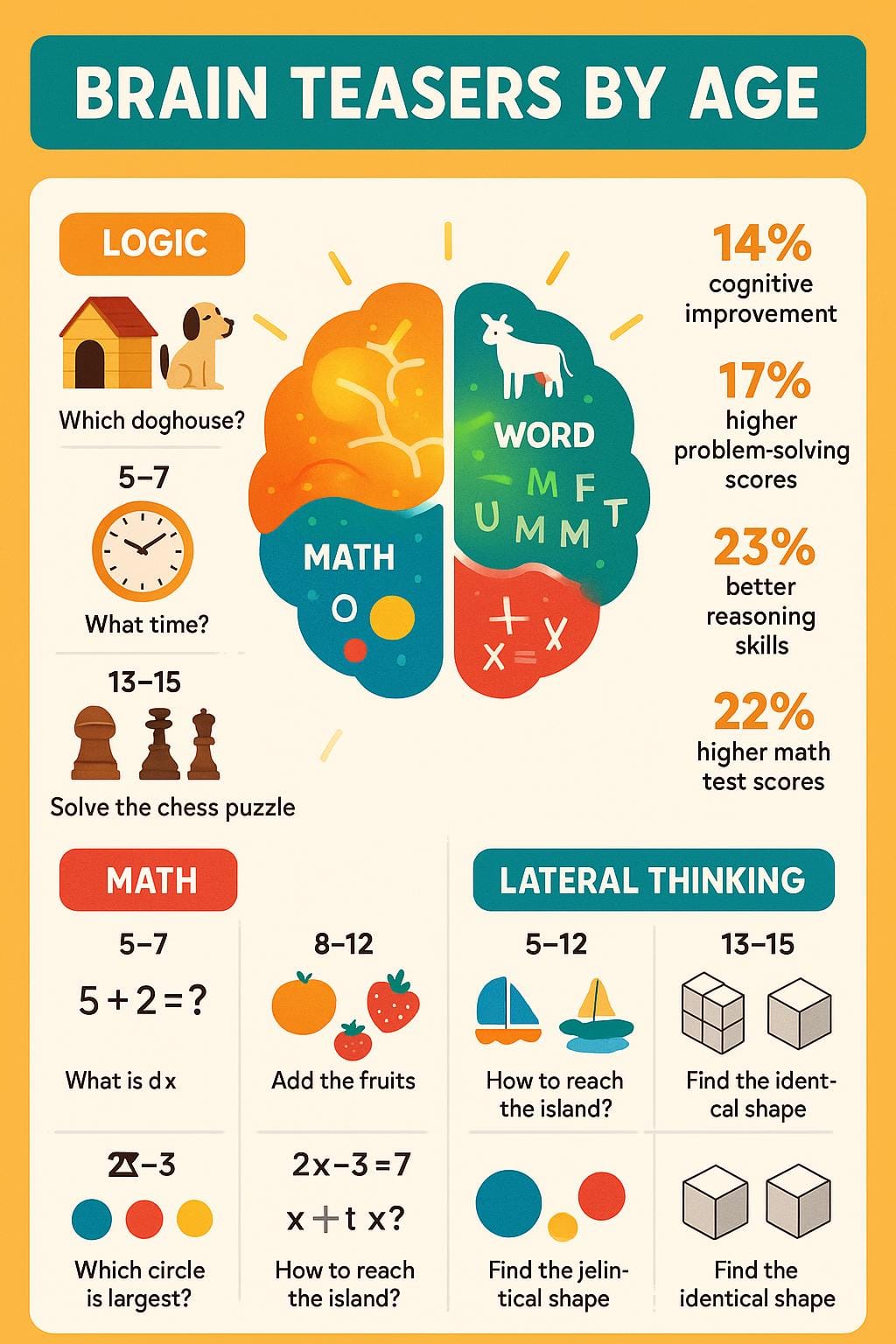
Logic puzzles form the foundation for systematic thinking and inference skills. These brain teasers teach children to evaluate premises, apply rules, and reach sound conclusions through methodical problem-solving. Research from Stanford University indicates that just 30 minutes of logic puzzle solving three times weekly can improve deductive reasoning skills by 23%.
Different age groups benefit from specific types of logic challenges. For ages 5-7, simple pattern completion and spot-the-difference puzzles build foundational skills. Children aged 8-12 thrive with junior Sudoku and grid-based logic problems, while teens can tackle more complex challenges like Knights and Knaves puzzles that require sophisticated propositional logic.
One excellent example is “The Birthday Party Mystery,” a who-sits-where puzzle with clues about seating arrangements. This type of puzzle strengthens prefrontal cortex function and enhances working memory capacity as children must hold multiple variables in mind while working toward a solution.
Related Guides: Check out our related articles for more helpful tips and insights.
Word Play and Language Puzzles: Verbal Intelligence Boosters
Word-based brain teasers provide exceptional benefits for linguistic development and verbal processing. A longitudinal study by the University of Edinburgh found that regular word puzzle solvers showed cognitive function equivalent to people 10 years younger. These mental exercises strengthen semantic networks and phonological awareness while making vocabulary acquisition more engaging.
For younger children (ages 5-7), simple anagrams, rhyming riddles, and word searches with picture clues provide age-appropriate challenges. As children grow, they can progress to word ladders, rebuses, and age-appropriate crosswords that build more complex linguistic connections. Teenagers benefit from cryptic crosswords and etymology puzzles that deepen their understanding of language structure.
📦 Word Puzzle Favorites
- 🔗 Brain Games Kids Word Search – Gradually increasing difficulty levels
- 🔗 Scholastic Success With Vocabulary – Grade-specific word challenges
- 🔗 Bananagrams – Fast-paced word game for the whole family
As an Amazon Associate, I earn from qualifying purchases.
Mathematical Challenges: Number Sense and Pattern Recognition
Mathematical brain teasers develop quantitative reasoning that extends well beyond standard curriculum. According to research from Johns Hopkins University, students who regularly solve math puzzles score 22% higher on standardized math tests. These puzzles build number sense and pattern recognition while making abstract mathematical concepts more concrete and accessible.
Age-appropriate math challenges ensure children experience productive struggle without frustration. Simple counting puzzles and visual pattern completion work well for ages 5-7, while elementary-aged children benefit from math riddles and arithmetic puzzles with multiple operations. Teenagers can tackle probability problems and algebraic thinking challenges that prepare them for advanced mathematics.
“The Four 4s Challenge” represents a perfect example of an engaging mathematical brain teaser. This puzzle challenges players to create every number from 1-20 using exactly four 4s and mathematical operations, activating the parietal lobe and building mathematical intuition.
Related Guides: Check out our related articles for more helpful tips and insights.
→ The Neuroscience of Doing Nothing: Why a Lazy Summer Day is Key to Academic Success
Lateral Thinking Problems: Cultivating Creative Problem-Solving
Lateral thinking puzzles teach children to approach problems from multiple perspectives, breaking free from conventional thought patterns. Research from the University of California found these exercises improved divergent thinking scores by 29% in adolescents. These unique challenges build cognitive flexibility and perspective-shifting abilities that transfer to real-world innovation.
Each age group benefits from specific types of lateral thinking challenges. Simple “what’s different” scenarios work well for young children, while elementary students can tackle situation puzzles and creative constraints problems. Teenagers benefit from classic lateral thinking scenarios that require questioning fundamental assumptions about how the world works.
| Product | Best For | Key Feature | Price Range | Shop Now |
|---|---|---|---|---|
| ThinkFun Gravity Maze | Ages 8+ | Marble Run Logic Game | $$ | View Deal |
| IQ Link Puzzle | Ages 6+ | Portable Spatial Reasoning | $ | View Deal |
| Perplexus Epic | Ages 10+ | 3D Maze Challenge | $$ | View Deal |
As an Amazon Associate, I earn from qualifying purchases.
For practical implementation, consider establishing a weekly family puzzle night with progression through difficulty levels based on success. This creates both cognitive benefits and valuable family bonding opportunities. I’ve found that setting aside 30 minutes three times weekly for brain teaser activities creates noticeable improvements in problem-solving approaches.
Related Guides: Check out our related articles for more helpful tips and insights.
→ Pareidolia: Seeing Patterns in Random Things (And Why It Matters)
🛠️ My Complete Brain Teaser Toolkit
Here’s everything I personally use and recommend:
As an Amazon Associate, I earn from qualifying purchases.
📚 Recommended Reading
- 📖 Puzzle Ninja by Alex Bellos – Perfect for parents seeking cutting-edge puzzles
- 📖 Brain Games For Kids: The Complete Series – Age-appropriate puzzles for every developmental stage
As an Amazon Associate, I earn from qualifying purchases.
Sources
Frontiers in Psychology: Cognitive Benefits of Puzzle-Based Learning
Science Direct: Puzzle Play and Cognitive Development in Children
Journal of Genetic Psychology: Longitudinal Effects of Puzzle Engagement
Nature Partner Journal: Science of Learning – Cognitive Training Effects
Journal of Experimental Child Psychology: Problem-Solving Transfer Skills